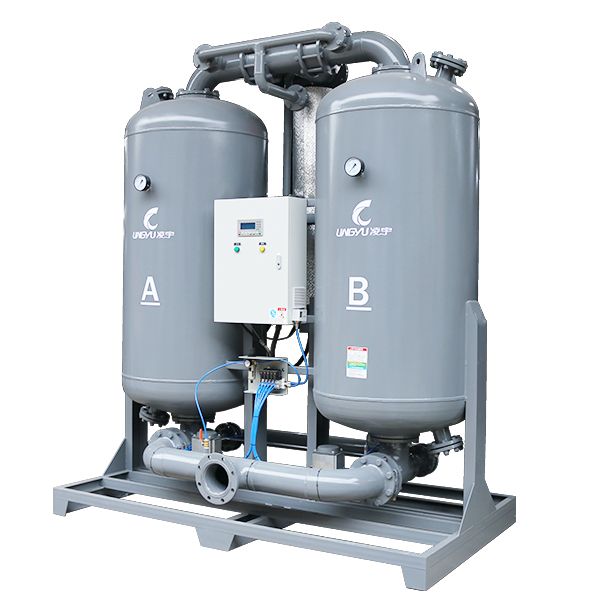
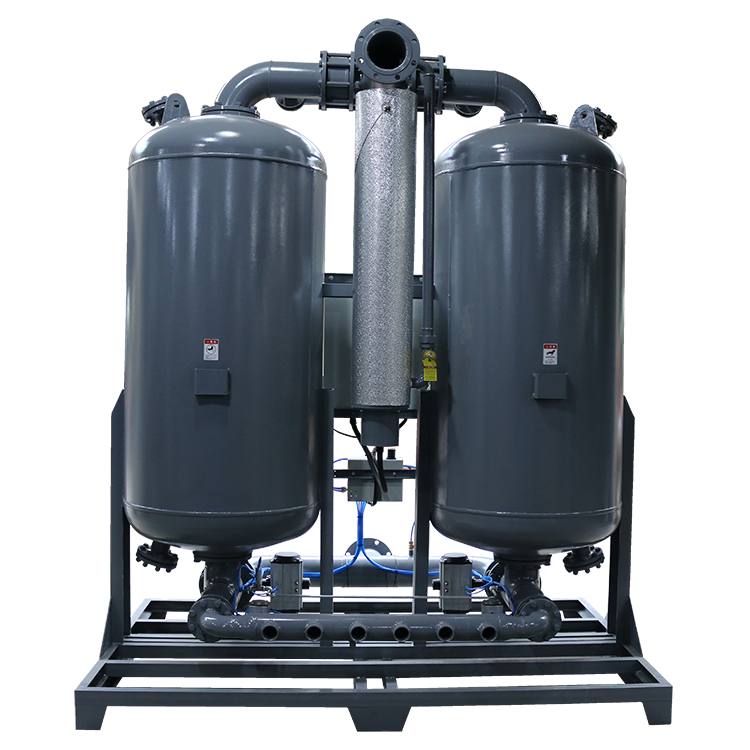
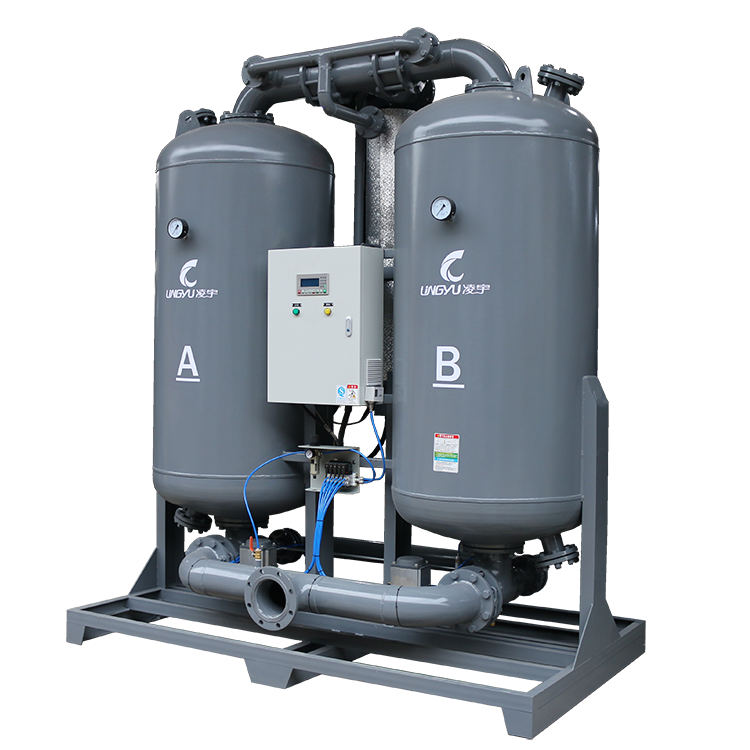
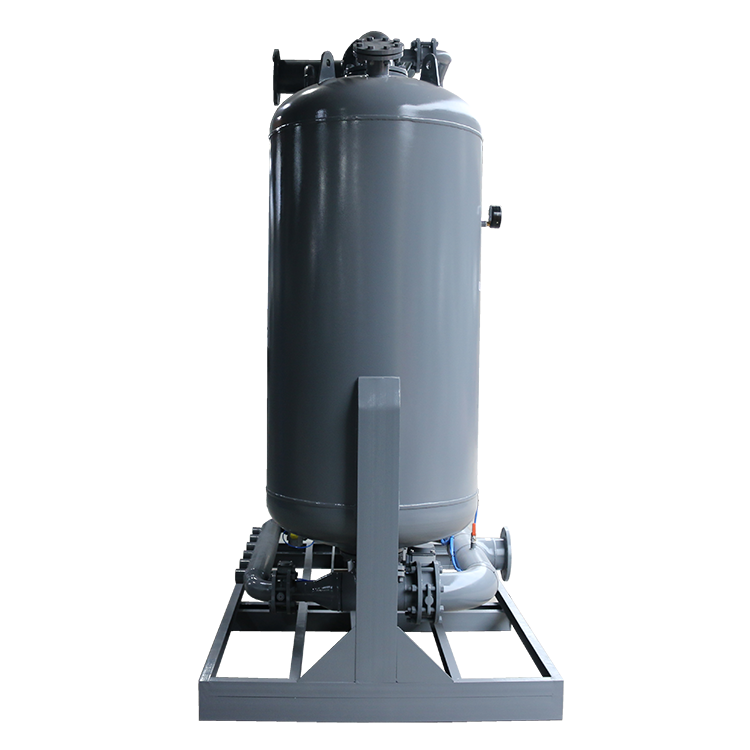
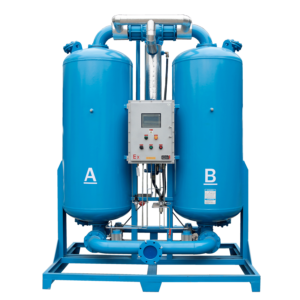
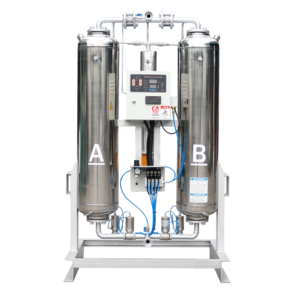
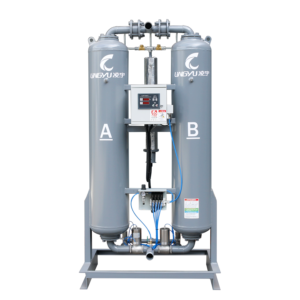
The micro-heat regenerated adsorption dryer operates on the principle of temperature swing adsorption (TSA). In this process, the adsorbent absorbs moisture at normal temperature, and when heated, the absorbed moisture is released back into the gas phase. The process provides the necessary heat for desorption from an external heat source while using part of its own dried gas as a heat carrier. During thermal regeneration, the complete release of moisture into the gas phase does not mean the adsorbent is fully regenerated. The original adsorption activity is only restored when the temperature returns close to its initial value. Therefore, regeneration in a micro-heat adsorption dryer must follow a two-step process: first “heating and desorption,” followed by “cooling and adsorption”; desorption is only one step in the overall adsorbent regeneration process.
| Processing Capacity (m³/min) | Power Supply V/Hz | Total Power kW | Inlet/Outlet Connection | Equipment Weight kg | Dimensions (L×W×H mm) |
|---|
| 1.5 | 380/50 | 1.7 | G1″ | 125 | 725×630×1795 |
| 2.5 | 380/50 | 1.7 | G1″ | 180 | 840×570×1695 |
| 3.8 | 380/50 | 2.5 | G1¾” | 310 | 1020×610×1690 |
| 6.5 | 380/50 | 3.7 | G1½” | 436 | 1160×680×1860 |
| 10.5 | 380/50 | 3.7 | G2″ | 610 | 1200×720×2180 |
| 13.5 | 380/50 | 6.1 | G2″ | 720 | 1260×780×2230 |
| 17.0 | 380/50 | 10.0 | DN65 | 850 | 1350×930×2440 |
| 21.5 | 380/50 | 10.0 | DN80 | 1000 | 1470×1000×2270 |
| 25.0 | 380/50 | 10.0 | DN80 | 1100 | 1460×1000×2470 |
| 28.5 | 380/50 | 10.0 | DN80 | 1280 | 1560×1070×2450 |
| 32.0 | 380/50 | 13.1 | DN80 | 1350 | 1600×1050×2650 |
| 37.0 | 380/50 | 13.1 | DN100 | 1550 | 1700×1100×2680 |
| 41.5 | 380/50 | 13.1 | DN100 | 1700 | 1830×1150×2700 |
| 45.0 | 380/50 | 20.1 | DN100 | 1830 | 1830×1150×2790 |
| 50.0 | 380/50 | 20.1 | DN100 | 2000 | 2040×1240×2780 |
| 55.0 | 380/50 | 20.1 | DN100 | 2170 | 2040×1240×2875 |
| 60.0 | 380/50 | 27.1 | DN100 | 2460 | 2130×1300×2790 |
| 65.0 | 380/50 | 27.1 | DN125 | 2650 | 2210×1340×2970 |
| 75.0 | 380/50 | 27.1 | DN125 | 3100 | 2350×1380×2920 |
| 85.0 | 380/50 | 34.1 | DN125 | 3200 | 2350×1380×2920 |
| 95.0 | 380/50 | 34.1 | DN150 | 4000 | 2446×1430×3170 |
| 110.0 | 380/50 | 42.1 | DN150 | 4700 | 2610×1580×3060 |
| 130.0 | 380/50 | 50.1 | DN150 | 5140 | 2900×1400×3079 |
| 150.0 | 380/50 | 55.1 | DN200 | 6100 | 3100×1580×3274 |
Note: If the air flow exceeds 150 m³/min or if special specifications, materials, or temperature requirements are needed, please contact our company or agents for technical consultation. The above data is for reference only and may change without notice. For other specifications, please contact us directly.
In India’s hot temperatures, seasonal humidity, and demanding industrial environments, compressed air systems often face a higher moisture load. This micro-heat regenerated adsorption dryer is designed to provide stable low-dew-point air for applications that require dry, reliable compressed air or non-corrosive gas treatment.
With an outlet dew point of ≤ -40°C, regeneration gas consumption of 4%–8%, and an operable ambient temperature range of 2°C to 45°C, it is well suited for industrial users in India who need dependable moisture control, especially in regions affected by heat, humidity, and monsoon conditions.
Typical Applications
- Pharmaceutical manufacturing and packaging
- Food processing and dry food packaging
- Beverage bottling and PET blowing
- Electronics and component assembly
- Automotive and auto-parts production
- Pneumatic painting and coating lines
- Medical air systems and laboratory equipment
- Pneumatic automation systems and robotics
- CEMS and analytical instruments
- Dry nitrogen replacement and gas drying support
Why It Fits These Applications
This dryer is suitable for processes that require:
- Stable low dew point air to prevent moisture contamination
- Reliable drying performance in hot and humid operating conditions
- Energy-efficient regeneration with low purge gas consumption
- Clean, dry compressed air for sensitive pneumatic and process equipment
Application Note
For Indian factories operating in high-humidity or coastal regions, proper pre-filtration, after-cooling, and condensate removal are recommended to help maintain stable dryer performance and extend adsorbent life.
Explore More Industry Applications