An industrial hot air dryer is a widely used drying system designed to remove moisture from materials through controlled hot air circulation. It plays a critical role in manufacturing processes where stable moisture control, consistent quality, and high production efficiency are required. From food processing to plastics, chemicals, and textiles, hot air dryers remain one of the most reliable and versatile industrial drying technologies.
What Is an Industrial Hot Air Dryer?
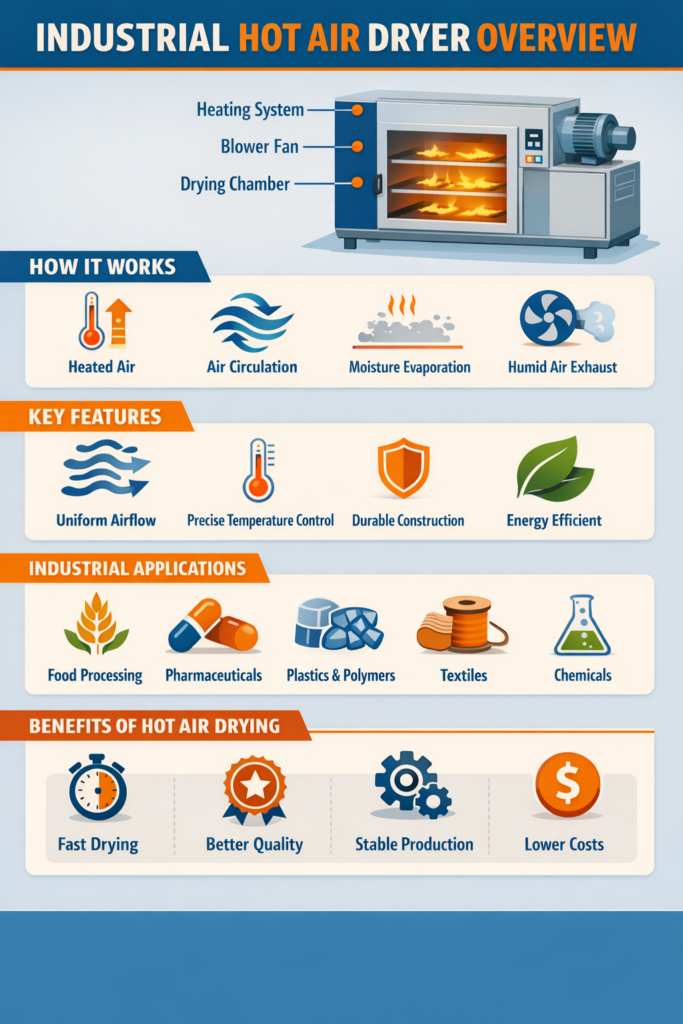
An industrial hot air dryer is a machine that uses heated air combined with forced airflow to evaporate and remove moisture from products or raw materials. Unlike natural or ambient drying, hot air drying significantly shortens drying time and ensures uniform results.
Typical components include:
Heating system (electric, gas, or steam)
High-efficiency blower or fan
Insulated drying chamber
Temperature and airflow control system
By precisely controlling temperature and air movement, industrial hot air dryers deliver repeatable and stable drying performance.
How an Industrial Hot Air Dryer Works
The drying process follows a simple but effective principle:
Ambient air is heated to a preset temperature
Hot air is circulated evenly across the material surface
Moisture evaporates due to heat transfer
Humid air is discharged or partially recirculated
This process continues until the desired moisture level is reached. Proper airflow design ensures that products dry evenly without overheating or deformation.
Key Features of Industrial Hot Air Dryers
Industrial hot air dryers are engineered for continuous operation in demanding environments. Common features include:
Uniform Air Distribution
Optimized airflow paths ensure consistent drying across all materials, reducing quality variations.
Accurate Temperature Control
Digital or PID temperature control allows precise adjustment for heat-sensitive materials.
Durable Industrial Construction
Heavy-duty insulation and corrosion-resistant materials support long service life.
Energy-Efficient Design
Heat insulation and optional air recirculation help reduce energy consumption.
Flexible Configurations
Available as cabinet dryers, tunnel dryers, conveyor dryers, hopper dryers, or customized systems.
Benefits of Using an Industrial Hot Air Dryer
Choosing an industrial hot air dryer brings several operational advantages:
Faster Drying Cycles
Hot air significantly accelerates moisture evaporation.Improved Product Quality
Uniform drying prevents cracking, warping, and moisture-related defects.Stable Production Output
Reliable drying reduces downtime and process variability.Lower Operating Costs
Efficient heat utilization minimizes wasted energy.Wide Application Range
Suitable for solids, powders, pellets, sheets, and coated products.
Common Industrial Applications
Industrial hot air dryers are used across many industries:
Food Processing
Drying grains, fruits, vegetables, spices, and food ingredients to extend shelf life.
Pharmaceuticals
Moisture removal for powders, granules, and tablets to ensure formulation stability.
Plastics & Polymers
Pre-drying plastic pellets and resins before injection molding or extrusion.
Textiles
Drying fabrics after washing or dyeing to improve finish quality.
Chemicals
Drying chemical powders, pigments, and intermediates while maintaining material integrity.
How to Choose the Right Industrial Hot Air Dryer
Selecting the right dryer depends on several key factors:
Material Characteristics
Moisture content, particle size, and heat sensitivity all influence dryer selection.
Required Drying Capacity
The dryer must match your production volume to avoid bottlenecks.
Temperature Range
Ensure the system can operate safely within your process temperature limits.
Energy Efficiency
Well-insulated designs and optimized airflow reduce long-term costs.
Automation Level
Advanced controls help achieve consistent and repeatable drying results.
Product Recommendations:
The independently developed EBZ200-2 multi-core driver can save more than 10% of the comprehensive energy consumption compared with the fixed cycle mode;
The optional dew point energy-saving control can extend the adsorption time and reduce the comprehensive energy consumption by more than 30% under load fluctuation conditions;
The communication can meet the user’s requirements such as RS-485 (standard), IoT connection, etc.
The optional dew point energy-saving control can extend the adsorption time and reduce the comprehensive energy consumption by more than 30% under load fluctuation conditions;
Customized high-performance adsorbent, 20% filling margin;
Installation and Maintenance Tips
To ensure long-term performance:
Install the dryer in a well-ventilated area
Ensure proper exhaust or moisture discharge
Regularly inspect heaters, fans, and airflow paths
Clean filters and air ducts to maintain efficiency
Monitor temperature and safety protection systems
Routine maintenance helps prevent uneven drying and extends equipment lifespan.
Conclusion
An industrial hot air dryer is a proven and efficient solution for moisture removal in industrial production. Its ability to deliver fast, uniform, and controllable drying makes it suitable for a wide range of materials and industries. With the right configuration and proper operation, a hot air dryer can significantly improve product quality, production efficiency, and overall process reliability.